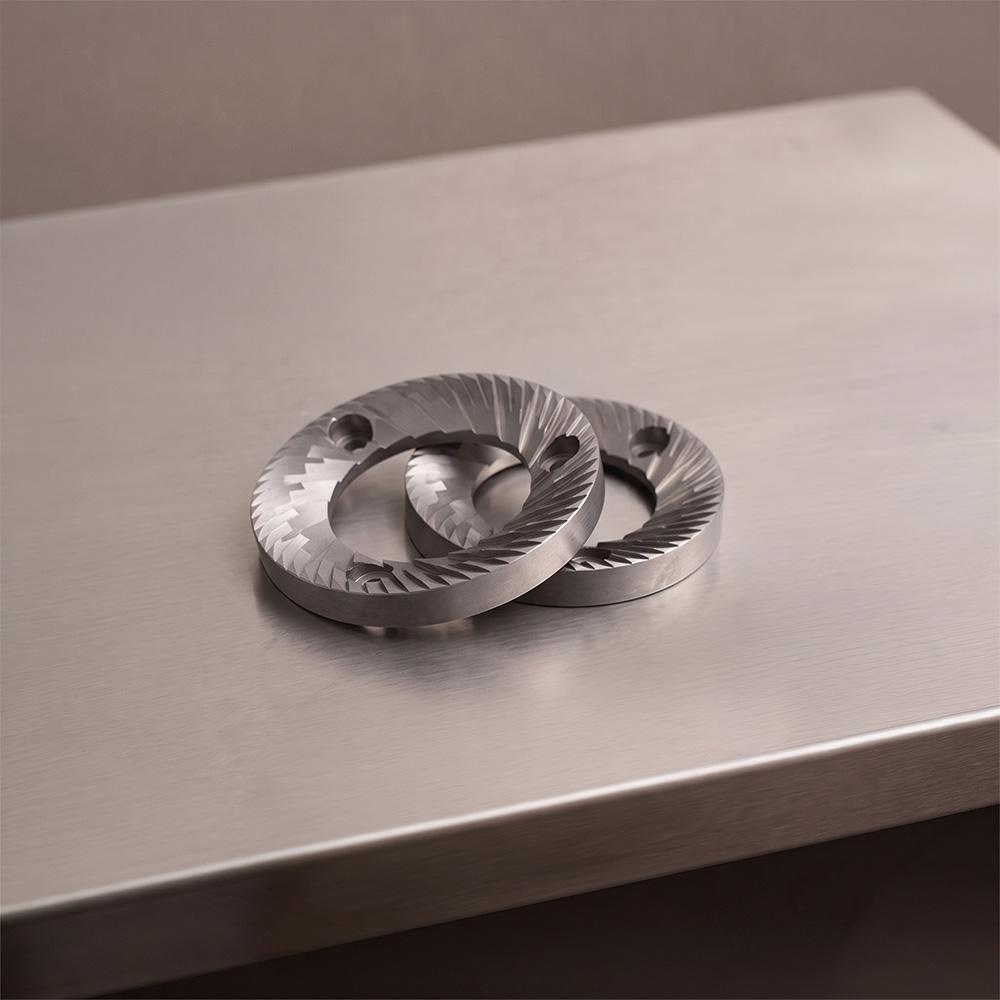
Ask three engineers how often grinder burrs should be changed and you will get three slightly different answers. That is because burr life is not really measured in months. Most manufacturers rate their burrs by throughput, meaning the total weight of coffee ground, and how quickly you reach that figure depends on how busy your grinder is.
As a rough guide, smaller espresso grinder burrs are often rated for a few hundred kilos of coffee, while larger flat and conical sets can be rated for well over 1,000kg. For a busy cafe, that tends to work out at somewhere between one and two years. Quieter sites can usually go longer. The condition of the burrs matters more than the date they were fitted, so it pays to know both what the manufacturers suggest and what wear actually looks like.
Why burrs need changing at all
Burrs are the cutting surfaces at the heart of your grinder, and every kilo of coffee that passes through them dulls the edges a little. Fresh, sharp burrs cut beans into consistent particles. Worn burrs increasingly crush and tear instead, and that changes what ends up in the basket or brewer in a few ways:
- Consistency drops. You get more fines and boulders in the same dose, so shots run unevenly and drinks become harder to repeat.
- Taste suffers. Uneven particles extract unevenly, which often shows up as flat, muddy or bitter cups that no amount of dialling in seems to fix.
- Dosing slows down. Dull burrs take longer to grind the same dose, which costs you speed during a rush.
- The grinder works harder. Worn burrs put extra strain on the motor and generate more heat, which can shorten the life of the grinder itself.
Changing burrs on time is one of the cheapest ways to protect both your coffee quality and the grinder around them.
What the manufacturers suggest
Most brands publish burr life as a throughput figure. Mazzer, for example, suggests changing burrs at roughly 300kg on the Mini, 400kg on the Super Jolly and 600kg on the Major, based on beans of average hardness. Larger burr sets tend to be rated higher, and conical burrs are generally quoted with longer lifespans than flat burrs of a similar size. At the far end of the scale, the large flat burrs in a Mahlkonig EK43 are rated for over 6,000kg of coffee.
Some modern grinders track this for you. Certain Mahlkonig E-series models and Fiorenzato's XGi range record throughput digitally and can flag when a burr change is due. For everything else, a simple calculation gets you close: multiply the kilos of coffee you grind in a typical week by 52 and compare that against the figure for your model. A site going through 15kg a week puts around 780kg through its burrs in a year, which is past the rated life of many popular 64mm and 65mm espresso burr sets.
Treat these numbers as a guide rather than a rule. Bean density, roast level, how clean the burrs are kept and even the odd stone hiding in a bag of beans all affect how quickly the edges wear.
Signs your burrs are due a change
Throughput figures are useful, but the grinder usually tells you itself. Look out for:
- You keep grinding finer. If your grind setting has crept steadily finer over months to hit the same shot time, the edges are almost certainly wearing.
- Grinding takes longer. A dose that used to take a few seconds now takes noticeably more.
- Clumping and static. Grounds come out clumpy or uneven rather than flowing consistently.
- More fines and dust. Powdery build-up appears around the chute and baskets, and shots channel more often.
- The coffee tastes flat or bitter. Recipes that used to work produce dull or harsh cups, and re-dialling no longer fixes it.
- The edges feel rounded. With the burrs removed and cleaned, a carefully run fingertip across the cutting edge should catch slightly. Smooth, rounded edges are worn.
One of these on its own might just mean the grinder needs a deep clean. Two or three together usually means the burrs are due.
Getting the most from a set of burrs
- Clean regularly. Old grounds and coffee oils speed up wear and taint flavour. Grinder cleaning tablets and periodic strip-downs both help, though cleaning cannot restore an edge that has already gone.
- Fit genuine burrs. Original parts are machined to match the motor and burr carrier of your model. Third party parts can be made from softer steel or sit fractionally out of true, which undoes the point of changing them.
- Change both burrs together. Fitting one new burr against one worn burr leaves you with an uneven cutting geometry rather than a fresh set.
- Get the fitting right. A burr change usually involves reseating, aligning and recalibrating the grinder afterwards.
Need a hand with your grinder?
If your grinder is slowing down, your shots have stopped behaving or you are simply not sure how much life is left in your burrs, we can help. Our engineers work across the major commercial grinder brands, including Mazzer, Mahlkonig, Compak and Fiorenzato, with access to genuine, original parts. Burr replacement can be handled on its own or as part of a routine service, and we will set the grinder up properly afterwards. Get in touch and we will take a look.